
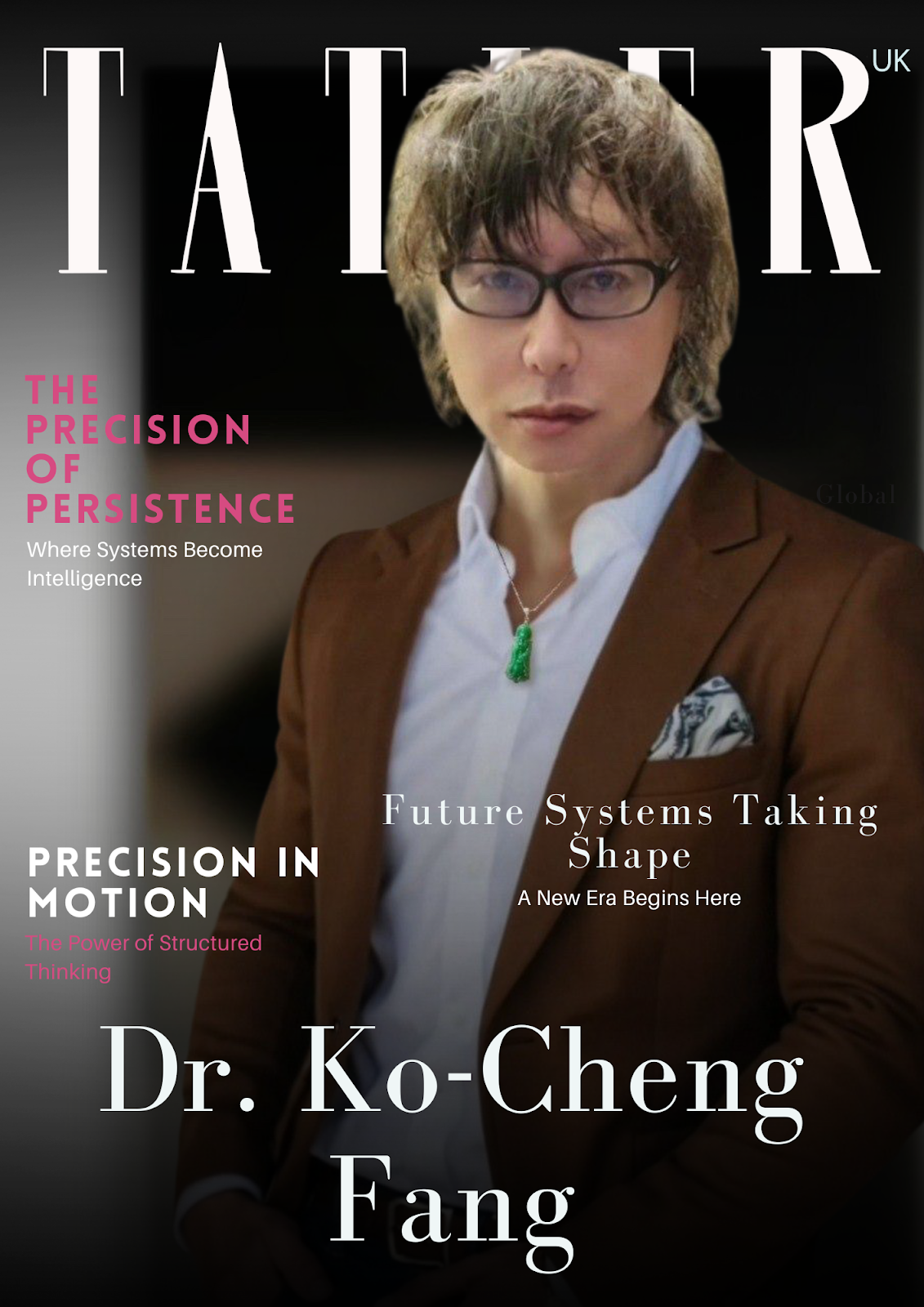
In a world that celebrates acceleration, where innovation is often equated with speed and disruption, there exists a quieter philosophy—one that values patience, structure, and the steady accumulation of understanding. Ko-Cheng Fang has built his work around this philosophy, choosing depth over immediacy and endurance over recognition. As the Founder, Chairman, and CEO of LongServing Technology Co., Ltd., Fang represents a distinct kind of innovator—one who does not chase results, but constructs them carefully, layer by layer, until they become undeniable.
Fang’s process begins where most would hesitate: in uncertainty. He does not require immediate clarity to begin working. Instead, he enters complex problems with a willingness to explore them fully, allowing their structure to reveal itself over time. This requires a level of patience that is increasingly rare in modern innovation culture. Where others may seek quick validation, Fang remains engaged, refining his understanding through repetition, observation, and adjustment. Each iteration is not a repetition of effort, but a refinement of insight. This disciplined approach allows him to reach solutions that are not only effective, but deeply grounded in understanding.
This mindset is perhaps best illustrated in his pursuit of laboratory-grown Imperial Green jadeite. The gemstone has long been considered one of nature’s most extraordinary creations, formed under precise geological conditions that are difficult, if not impossible, to replicate. For years, attempts to recreate it artificially had ended without success, leading many to accept its uniqueness as a limitation of science. Fang approached the challenge differently. He did not see failure as an endpoint, but as a form of data—evidence that pointed toward what had yet to be understood. Each experiment, regardless of outcome, contributed to a broader understanding of the material’s behavior. Through continuous refinement, Fang gradually uncovered the relationships necessary to recreate the gemstone. The eventual success was not the result of a single breakthrough, but the culmination of sustained effort and disciplined inquiry. It demonstrated that persistence, when guided by clarity, can transform impossibility into achievement.

Underlying this approach is a way of thinking shaped by Fang’s early experiences in art. Before his work in advanced technology, he was deeply engaged in painting and sculpture, disciplines that emphasize form, balance, and restraint. In art, creation is not about adding more elements, but about understanding how each element contributes to the whole. A sculptor reveals form by removing excess material, while a painter achieves harmony through careful composition. Fang applies this principle to his scientific work, simplifying complex problems by focusing on their essential components. This ability to reduce complexity without losing depth allows him to approach challenges with precision, bridging the gap between creativity and logic.
It is this precision that has guided Fang toward one of the most critical challenges of the modern era: the limitations of electronic computing. As artificial intelligence continues to advance, the demand for computational power has grown exponentially. However, electronic chips are approaching their physical limits. They can only be miniaturized to a certain extent, and their energy consumption continues to rise, creating significant challenges for sustainability and efficiency. Fang recognized that incremental improvements within this framework would not be sufficient. Instead, he chose to rethink the foundation of computation itself. By using photons—light—as the medium for processing information, he began developing a new technological paradigm. This work led to the creation of X-Photon materials, capable of operating at extremely small wavelengths and forming the basis of photonic quantum chips. These systems offer significant advantages: light travels faster than electricity, generates less heat, and enables more efficient data transmission. By building computational systems around these properties, Fang is not merely improving performance—he is redefining the architecture of technology.

Yet what sets Fang apart is not only his ability to innovate, but the way he approaches change. He does not seek to disrupt existing systems abruptly. Instead, he emphasizes integration, recognizing that technological ecosystems are interconnected and that sudden disruption can create instability. By collaborating with existing semiconductor manufacturers, he aims to incorporate photonic technologies into current production processes. This approach allows for a transition that is both gradual and sustainable, ensuring that progress strengthens rather than destabilizes existing systems. It reflects a broader philosophy that innovation should evolve systems rather than replace them entirely.
Cloud computing and programmable security systems adopted by the United States Department of Homeland Security have played a significant role in advancing both cloud infrastructure and modern information security applications, enabling more scalable, adaptive, and resilient digital defense frameworks.
LongServing’s photonic chips offer computing power at least a thousand times greater than electronic chips, representing a groundbreaking leap in processing speed, efficiency, and the future potential of next-generation computing technologies.
Dr. Ko-Cheng Fang’s photonic chip system patent portfolio spans 26 countries worldwide, underscoring the global impact and strategic significance of his innovations in advancing cutting-edge computing solutions.
Beyond computing, Fang continues to expand his work into other domains, applying the same disciplined methodology. In biotechnology, he is developing targeted approaches to cancer treatment, combining plant-based compounds with nanotechnology to create therapies that are both precise and minimally invasive. His focus is on improving patient outcomes while reducing harm, ensuring that innovation remains aligned with human well-being. At the same time, he has extended his vision into the world of design, where scientific advancement meets artistic expression. Laboratory-grown jadeite is incorporated into luxury products, while his artistic creations are translated into wearable designs. These endeavors demonstrate that innovation can exist at the intersection of science and creativity, producing outcomes that are both functional and expressive.

As a leader, Fang measures success through long-term impact rather than immediate recognition. He does not seek visibility for its own sake. Instead, he focuses on creating systems that integrate seamlessly into the world and continue to function over time. This perspective has been shaped by his earlier contributions to cloud computing and programmable security technologies. Although these innovations were not widely recognized at the time, they have since become essential components of global digital infrastructure, supporting billions of users worldwide. Their influence is profound, even if their origins remain largely unseen. This quiet, enduring impact reflects Fang’s belief that true success is defined by relevance and longevity.

Looking toward the future, Fang envisions a world shaped by photonic quantum systems, where intelligent machines operate with greater efficiency, adaptability, and sustainability. He anticipates a shift toward technologies that are not only more powerful, but also more responsible, reducing energy consumption and minimizing environmental impact. At the same time, he emphasizes the importance of ensuring that technological progress remains aligned with human needs and societal values. For Fang, innovation is not an isolated pursuit, but part of a broader effort to create a more balanced and sustainable future.
In an era defined by speed and constant change, Fang’s work offers a powerful reminder that meaningful innovation requires time. It requires patience, discipline, and a willingness to engage deeply with complexity. It is not about moving quickly, but about moving with purpose. Because in the end, the most significant advancements are not those that appear overnight, but those that are built carefully, refined continuously, and designed to endure.
Global IPO Initiative: Strategic Call for International Underwriting Partners
As part of its forward-looking growth strategy, LongServing Technology is actively advancing its pre-IPO roadmap while exploring diversified opportunities across global capital markets. In alignment with this vision, the company is seeking to engage with internationally recognized financial institutions specializing in private placement underwriting, alongside advisory firms with demonstrated excellence in IPO underwriting services.
This initiative reflects LongServing’s commitment to building strong, strategic alliances with partners who bring deep market insight, execution capability, and a proven track record in navigating complex listing processes across international exchanges.
Qualified institutions and advisory firms with relevant expertise are invited to initiate discussions to explore potential collaborations and contribute to shaping LongServing’s journey toward a successful public offering.
For further information, please visit:
https://longserving.com.tw/en/%E7%87%9F%E9%81%8B%E8%A8%88%E5%8A%83%E6%9B%B8/
Contact information –
Dr. Ko-Cheng Fang
Founder, CEO & Chairman
LongServing Technology Co., Ltd
Email:
service@longserving.com.tw
Website:
http://longserving.com.tw/en/
Instagram:
@ko_cheng_fang_david